Monday, May 4, 2015

Rottweiler Ear Tapping

WHY DO PEOPLE TAP ROTTWEILER EARS ? 

Rottweiler Ear TappingRottweiler ears are correctly carried if they lay close to the head. 

Some Rottweiler ears are either set or carried incorrectly and it distracts from the appearance of a strong, broad head, if so you must interven by taping the ears overwise they may remain that way.


Taping will not effect how high the ears are set but will help to greatly improve how the ears are carried. 

Ear taping is simple, non invasive, and only has to stay on for a couple of days.

Thursday, April 30, 2015

Why do people dock Rottweiler's tail ?


Rottweiler Tail Docking

Rottweiler Tail Docking
Rottweiler was always known as a working breed, at the time this breed was developed to prevent their tails from being grabbed by assailants and to prevent problems which a dog could have pulling the carts (such as the tail getting caught in wheels of the carts) people docked the tail of their Rottweilers. 
sponsored

Nowdays even though in some countries of United States of America and in some parts of the world, Rottweiler isn't known as a working breed but more as a guardian dog, people still dock rottweiler's tails for tradition and aesthetic reasons... 

Since tail docking is done at such a young age (1-3 days), they feel little to no pain because the nerve endings are still undeveloped...

Saturday, February 14, 2015

Bone Diseases that may haunt Rottweilers

1. Hip Dysplasia
This is a genetically inherited disease that affects Rottweilers. Along with genes, over-vaccination and obesity are the other common causes of this disease. It can range from mild abnormality to extreme dislocation of the joint.
Bone Diseases that may haunt Rottweilers
Hip Dysplasia
Symptoms
The dog could be limping or bunny hopping for a prolonged period of time.
Prevention
A good natural diet with supplements of chondro-protective medications should help your dog fight this disease.

2. Elbow Dysplasia
It is again a genetic disease, but can also be caused by a bad diet and injury. This disease causes the elbow joints of the front legs being malformed. This is because of the different growth rates of the three bones that form the elbow. This can also lead to osteoarthritis because the malformation damages the bones and cartilages. This problem can be seen when the pup is as young as four months.
Hip Dysplasia
Symptoms
One of the common symptoms is lameness of the front limb. Your dog might limp; he/she might stop putting weight on the front leg or drag it while walking. They may also hold the diseased leg away from body when they are walking.
Prevention
It is a lifelong problem and surgery is the only cure. In certain cases surgeries are ideal and can get rid of the disease all together.
3. Panosteitis
Panosteitis is also known as the long bone disease. It can cause sudden lameness in a growing pup or a young dog between 5 and 12 months of age. This disease can cause alternating lameness in one or more legs. The pain and limping can shift over a period of time that could be several weeks to months. The lameness is caused by excessive bone production in the front and hind legs. It generally effects dogs that are subjected a high protein diet.
Symptoms
It can cause inflammation, lameness and limping.
Prevention
Once over 18 months the dogs that are affected from this condition out grow the problem.
Rottweilers are large dogs that are prone to joint and bone diseases. Most of the diseases can be taken care by proper diet. /Article Source: http://EzineArticles.com/5689380/

Sunday, January 4, 2015

German Rottweilers

What Makes A German Rottweiler...... German?
German Rottweiler
In order to be considered German, a German Rottweiler has to be born in Germany, or have parents who are German born with ADRK (Allgemeiner Deutscher Rottweiler Klub) registration papers.

But of course, it's not that easy and this is just the beginning of the story. Given the above statement, then all other Rottweilers born across the world are also 'citizens' of their country of birth, but this doesn't explain why German Rottweilers are considered to be superior.
To fully understand that part, consider a puppy's pedigree as the document that determines the quality of that puppy. A pedigree shows a puppy's bloodlines (or ancestors) - think of it as your pup's 'Family Tree'.
The quality of the dogs in your puppy's pedigree directly affect the quality of your pup, both in terms of looks ('conformation'), temperament and health. THIS is where the superior quality of German Rottweilers is found.

It's also where some of the confusion over German v American Rottweilers is often found. Let's put it this way.....

If your puppy was born in New York for example, he is by definition an American Rottweiler (by birth). But that isn't what determines the size of his head, the quality of his hips, or the type of temperament he has. His bloodlines do that.

If his Sire and Dam are German born and ADRK registered, the chances of your puppy being an excellent representative of the breed are very high - regardless of which country he was born in.
But why is a German Rottweiler so much better than an American (or British, Belgian, Australian etc.) Rottweiler? Why is having German-born dogs in your pup's pedigree so important?
The answer to that lies with the ADRK in Germany. The ADRK is basically the German breed club for the Rottweiler (the 'parent breed club' you could say), and it's main goal is to protect the Rottweiler breed.
What do I mean by 'protect the Rottweiler breed'? Well, the original slogan of the ADRK was
'Rottweiler breeding is, and remains, the breeding of working dogs'
This is an still a very important point today. Always remember that although your little guy or girl may be destined for a life of luxury, as a much-loved family companion, the Rottweiler is a working breed.
Rottweilers shouldn't just look like Rottweilers, they should act and move like Rottweilers too, and have the ability to perform the tasks/duties that the breed was originally designed for.

Sunday, November 16, 2014

Tips to protect your Rottweiler from Cold Weather

          Caring about your Rottweiler in the winter          

    Rottweiler in winter cold weather snow / tips
  1. Check with your vet. Senior dogs, dogs with arthritis and puppies can be very sensitive to the cold weather. Ask your vet when is the perfect time to walk your dog and if it is okay to walk him.
  2. Know the signs of frostbite and hypothermia. The risk of these conditions is especially high when the temperature dips below 32 degrees Fahrenheit. Frostbite typically affects poorly insulated body parts such as the tips of the ears and is evidenced by skin that is pale or red, swollen and painful or numb. Signs of hypothermia include slow pulse, shallow breathing,  disorientation, collapse and unconsciousness. If you think your dog has either, call your vet immediately!
  3. Stick to fenced dog parks. More dogs are lost during the winter than any other season, possibly because dogs can lose your scent in snow or ice and become lost if they can’t see you.
  4. Trim your dog’s paws. If your dog has furry feet, ask your groomer to “scoop” the pads — trim the hair that grows between your dog’s toes and under his feet — during the winter to prevent ice buildup between the paw pads.
  5. Play fetch with toys, not sticks. Sticks — so plentiful in winter — can cause choking and severe injuries.
  6. Wipe your dog off as you get home. Balls of ice can form between your dog’s toes, and antifreeze, salt and other chemicals can stick to his paws and upset his stomach — or worse — when he licks them. Thoroughly wipe down your dog’s belly, legs and feet as soon you come home — and while you’re at it, check for issues such as dry and cracked paw pads.
  7. Avoid salt. Stick to dry or snow-covered areas where road salt has not been used to melt ice. Not only can it hurt your dog’s paws, many varieties contain harmful chemicals that can cause stomach upset and even death if ingested when your dog licks his paws./petfinder.com/

Tail standard of Rottweilers

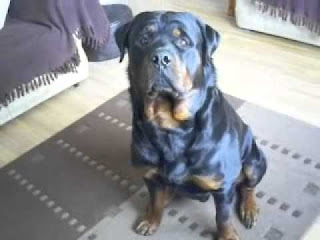
In many countries it is illegal to dock a dog's tail or crop a dog's ears, also in order to participate in dog's show a Rottweiler should have a natural tail. A Rottweiler's natural tail is carried hanging while at rest, and often over the back when excited. It normally has a slight curve.
sponsored


A Rottweiler dog does not hold it's tail in a stiff position sticking straight out from the body but instead it can be captured appearing to stick straight out by a camera, with the picture taken at exactly the right moment, as the tail wags back an forth. 

These are the Correct ways a Rottweiler keeps his tail !
Rottweiler tail standard

Sunday, November 9, 2014

Rottweiler Tips - Feeding your Rottie

Rottweiler feeding tips
The first and most important thing that contributes to your Rottweilers health is the food that you feed him or her.
Depending on the age of the Rottweiler, they need a certain amount of meat and nutrients to keep a balanced and nutritious diet.
sponsored


You can choose to feed them food from the store or you can make your own if you have the time.

Learn how to read the labels on the dog food before you purchase one.

It's important that the source of protein, whether it be chicken, lamb or beef, is the first ingredient listed on the label.

If your Rottweiler has allergies to certain things, that's something else you need to keep an eye out for.

Twitter Delicious Facebook Digg Stumbleupon Favorites More